
IMEG Insights
-

Making Operations Visible: The Power of Visual Management in Manufacturing
Imagine walking onto a manufacturing floor where you instantly know: What’s running on time (and what’s behind) What equipment is down for maintenance How much inventory is available at each station Where safety risks or quality alerts exist No need to ask. No need to dig through spreadsheets. That’s visual…
-

Optimizing Factory Layouts: A Deep Dive into Travel Distance Analysis
In manufacturing, every second and every step counts. While many companies focus on high-tech automation or sophisticated scheduling to boost productivity, one of the most overlooked sources of wasted time and cost is excessive travel distance on the shop floor. Travel distance refers to the physical movement of people, materials,…
-

The Foundation of Quality — Understanding Process Flow Diagrams
In every well-run manufacturing environment, quality doesn’t start at inspection – it starts with clarity. Clear processes, clear responsibilities, and clear documentation form the backbone of effective quality management. What Is a Process Flow Diagram (PFD)? A Process Flow Diagram is a visual representation of the steps involved in a…
-

The Science of Work Sampling: A Data-Driven Approach to Operational Efficiency
Ever wonder why your manufacturing facility is unable to meet its productivity and efficiency standards despite seemingly optimal conditions? In manufacturing and industrial environments, understanding how time is spent on the shop floor is essential for driving productivity and reducing waste. That’s where work sampling comes in. In this post,…
-

Understanding Your Production Capacity: A Key to Efficient Manufacturing
If you’ve worked in a factory for long enough, you’ve seen the signs: pallets stacking up at one end of the line, operators idle at the other, and supervisors scrambling to shift resources. On paper, everything should be fine. The orders are steady, the machines are running, and the team…
-

From Chaos to Clarity: How 6S Transforms Manufacturing Floors
You walk through the plant floor at the start of your shift. There’s a pallet jack parked in front of a fire exit, hand tools scattered across a workbench, and inventory tags that don’t match the contents of the bins. A newly hired operator is searching for the right wrench,…
-

Bringing Order to Complexity: The Power of AutoCAD Layering Standards
If you’ve ever opened a facility layout file from someone else — even a colleague within your own organization — you’ve probably felt that moment of confusion. “What am I looking at? Why are the workstations floating in midair? Is that line a wall, a conveyor, or an electrical line?…
-

The Do’s and Don’ts of Time Studies
In today’s competitive manufacturing environment, every second on the shop floor counts. That is why time studies remain one of the most powerful tools for identifying process inefficiencies, setting realistic labor standards, and laying the groundwork for continuous improvement. But like any tool, time studies are only as good as…
-
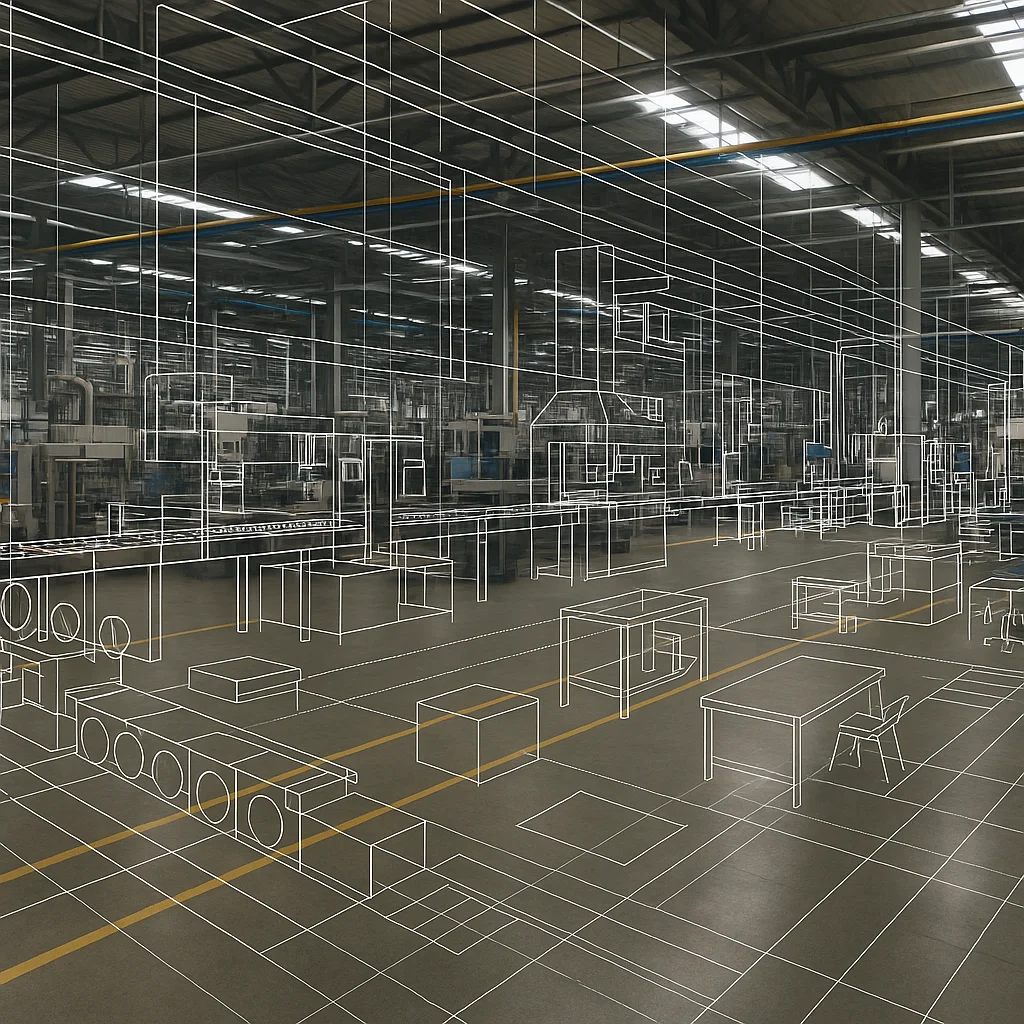
A Systematic Approach to Facility Layout Planning using AutoCAD
Why are good AutoCAD facility layouts important? In today’s competitive manufacturing and production environment, manufacturing facility layouts are an integral part of business planning. Poor facility layouts can result in excessive material handling, inefficient workflows, and wasted space while having the optimal layout boosts business productivity. That is why facility…
-

IMEG Standard Templates: Driving Clarity, Consistency, and Results
As engineers at IMEG, we’ve found that consistency is just as critical as creativity when solving complex manufacturing problems. Whether we’re optimizing a facility layout, conducting a time study, or modeling a new process, the structure behind the work matters. That’s why we use custom-developed engineering templates — a refined…