
In today’s competitive manufacturing environment, every second on the shop floor counts. That is why time studies remain one of the most powerful tools for identifying process inefficiencies, setting realistic labor standards, and laying the groundwork for continuous improvement.
But like any tool, time studies are only as good as the method used to perform them. In this post, we’ll explore the essential do’s and don’ts of time studies to help avoid common pitfalls and ensure that all efforts lead to accurate, actionable results.
A Time Study is a method used to measure how long it takes an average qualified worker to complete a specific task under normal conditions. By breaking the job into smaller elements and timing each one, businesses can determine a fair and consistent standard time for the task. This involves observing multiple cycles, applying a performance rating, and adding allowances for fatigue, delays, and personal needs.
In manufacturing, time studies are essential for setting labor standards, improving productivity, and supporting lean initiatives. They help identify inefficiencies, streamline processes, and ensure accurate planning for labor, cost, and capacity. When done correctly, a time study becomes a powerful tool for driving operational excellence and continuous improvement.
Before starting a time study, inform the employees involved and explain the purpose behind the study. Building trust is key. Operators must know that the study isn’t about policing their performance but about improving processes and setting fair expectations.
A time study is not just about watching and recording—it requires judgment. Observers must be trained to identify work elements, apply performance ratings, and remain objective throughout the study. IMEG engineers are trained and experienced in making these sort of judgements.
Time studies should follow a repeatable process. Whether using a stopwatch or performing a video analysis, consistency is critical. Establish clear procedures for how observations will be recorded and analyzed. IMEG engineers follow and use the expertly drafted IMEG SOP's and Templates that guide them when performing time studies.
Break down the job or process being studied into discrete elements. This allows for isolation of non-value-added activities (like walking or waiting) from value-added steps, which is vital for lean initiatives and process optimization. Doing so also helps set clear start and end triggers for each element thereby boosting accuracy of the time study. Breaking tasks down into elements is also necessary for any potential line balancing activities.
Observing one or two cycles does not provide reliable data. Aim to gather multiple observations across different operators, shifts, and conditions to get a comprehensive view of the process. IMEG’s standard template statistically evaluates the variation observed in collected data and determines an ideal number of observations needed to gain confidence in the results.
Note every detail: environmental conditions, equipment used, material availability, operator skill level, and any disruptions. This context is essential for isolating outliers, interpreting results, and improving processes effectively.
Trying to “just get it done” often leads to incomplete data and invalid conclusions. A proper time study takes time to plan, execute, and analyze. Skipping steps increases the likelihood of errors and employee pushback.
Outliers distort results. One fast cycle or one slow operator should not define a standard. Statistical significance matters. Multiple observations provide a more accurate average. IMEG’s standard template guides engineers in determining the ideal number of observation cycles needed to deliver a confident study.
Operators are experts in the work being studied. Involving them in the time study process provides unique insights that can improve the study’s quality and the resulting process improvements. IMEG engineers aim to communicate with the operators and develop a good working relationship with them so that they feel comfortable about the studies and are open to sharing their insights.
Most processes have a few non-cyclical elements mixed in with the cyclical elements. Non-cyclical elements do not occur every cycle but rather at a set frequency or whenever deemed necessary for the process. Identifying non-cyclical elements and properly accounting for them eases the process of incorporating them into Standard Times.
Things like machine downtime, material shortages, or even floor congestion can skew the data. It is important to account for these factors and separate them from the “normal” process steps.
Many time studies go sideways because observers forget to apply performance ratings and allowances. Normal time is the observed time adjusted for operator performance. Standard time includes additional allowances (for fatigue, personal time, and unavoidable delays). IMEG’s Time Study template allows the engineer to apply performance ratings and allowances as the study is being conducted or just right after thus ensuring it is accurately accounted for.
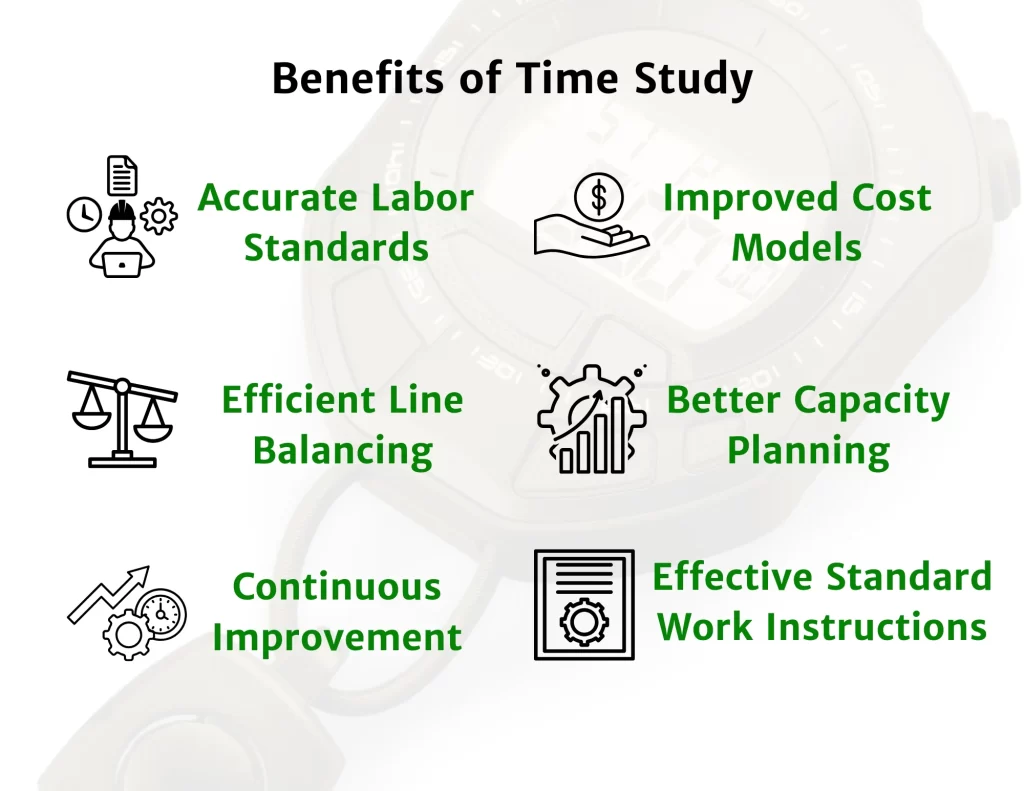
A well-executed time study supports broader operational goals such as:
At IMEG, we often use time studies as a launchpad for larger process improvement initiatives, helping manufacturers achieve measurable gains in throughput, quality, and workforce productivity.
Use video analysis to review performance without disrupting the floor.
Leverage use of standard observation forms and templates to streamline data collection and analysis.
Cross-train and study multiple observers to reduce individual bias and improve data reliability.
Document standard work immediately following the study to lock in improvements.
Time studies, when done right, are a gateway to smarter processes, better standards, and a more engaged workforce. By following these do’s and avoiding the common don’ts, you can maximize the impact of your time study efforts. Whether you’re just getting started or looking to refine your approach, a well-planned time study can reveal opportunities you didn’t know existed. To help you get started, we’ve created a Time Study Observation Template that makes it easier to structure your observations and capture reliable data.
If you’re considering a time study, or want to train your team to conduct them more effectively, IMEG can help. Our team works alongside your team to ensure accurate data collection, operator buy-in, and actionable outcomes.
IMEG can help, our team works alongside yours to ensure accurate data collection, operator buy-in, and actionable outcomes.
Contact Us