
The Science of Work Sampling: A Data-Driven Approach to Operational Efficiency

science of work sampling

Ever wonder why your manufacturing facility is unable to meet its productivity and efficiency standards despite seemingly optimal conditions? In manufacturing and industrial environments, understanding how time is spent on the shop floor is essential for driving productivity and reducing waste. That’s where work sampling comes in.

In this post, we’ll break down the science behind work sampling, when to use it, and how it can lead to measurable improvements in efficiency and labor utilization.

What is Work Sampling?

Work sampling is a statistical observation technique used to estimate the proportion of time spent on various activities. Rather than continuously monitoring a task, an observer records what activity is occurring at random intervals over a set period of time. It’s especially valuable for evaluating non-repetitive tasks, indirect labor, and large teams—situations where traditional time studies are not as effective.

For example, if you observe an operator 100 times and they’re actively working 75 of those times, you can estimate they’re productive 75% of the time.

This technique is ideal for:

  • Non-cyclical or unpredictable work patterns
  • Observing multiple employees or workstations simultaneously
  • Evaluating indirect labor (material handling, maintenance, etc.)

Work sampling was developed in the 1930s by L.H.C. Tippett and has since become a staple in industrial engineering, Lean Six Sigma, and continuous improvement initiatives.

How to Conduct a Work Sampling Study

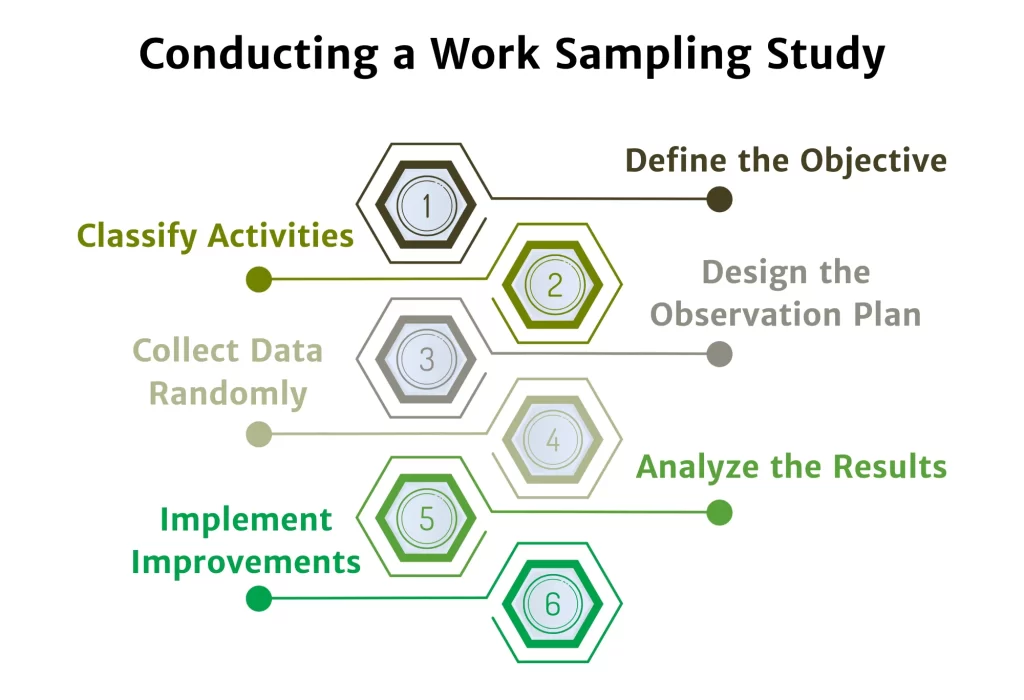
IMEG follows a general 6-step process when undertaking work sampling studies:

1. Define the Objective

What are you trying to measure? Employee utilization, machine uptime, or non-value-added time?

2. Classify Activities

Create clear activity categories such as:

  • Value Add Activities: Activities that physically alter the state of the product. Alternatively, all activities that the customer is willing to pay for. Examples: trimming, sanding, painting, casting, etc.
  • Non-Value Add Activities: Activities that do not alter the state of the product. Examples: loading into fixture, applying barcode label, cleaning, etc. Sometimes it may be necessary to differentiate essential and non-essential non-value add activities, especially when there are a lot of non-value add activities.
  • Delays: All activities that either cause a delay or happen when experiencing or trouble-shooting a delay. Examples: Conveyor down, broken tool, dropped parts, etc.
  • Personal Activities: Activities that are not related to the work being performed. Examples: Unscheduled breaks (water or bathroom breaks), avoidable talking or chatting, using personal devices, etc.

3. Design the Observation Plan

Determine how long the study will run, when observations will occur, and how many samples are needed for statistical reliability.

4. Collect Data Randomly

Observe and record what is happening at random intervals using an observation form or a digital tool.

5. Analyze the Results

Calculate time distribution by category. Identify patterns, trends, bottlenecks, inefficiencies, and improvement opportunities.

6. Implement Improvements

Use the findings to reallocate labor, redesign workstations, reduce delays, or revise standard operating procedures.

work sampling methodology

Benefits of Work Sampling

Work sampling aligns perfectly with Lean Manufacturing and Continuous Improvement principles by helping identify:

  • Non-value-added tasks
  • Bottlenecks and constraints
  • Opportunities for standardization

It’s a tool that supports PDCA (Plan-Do-Check-Act) cycles and Six Sigma DMAIC projects by providing hard data on where time is actually spent.

Accuracy vs Effort: Unlike time studies, which are detailed but time-consuming, work sampling offers a lower-effort, higher-scale alternative – ideal when you need insights across departments or large operations.

Key benefits of work sampling include:

Cost-Effective: Requires fewer resources than continuous observation

Scalable: Easily applied across multiple departments or facilities

work sampling operational efficiency

Supports Lean and Six Sigma: Quantifies waste and supports data-driven improvements

Broad Insights: Captures a wide view of operations over time

Non-Intrusive: Less disruptive than stopwatch studies

Common Pitfalls to Avoid

A successful study needs planning, consistency, and action on the insights. Following are a few pitfalls to avoid when performing and utilizing Work Sampling Studies.

  • Too Few Observations: Leads to inaccurate estimates
  • Unclear Activity Definitions: Causes inconsistent data
  • Observer Bias: Undermines statistical reliability
  • Lack of Follow-Through: Collecting data but not using it

Conclusion: A Powerful Tool in the Industrial Toolbox

Work sampling brings scientific rigor to the art of operational improvement. When used correctly, it reveals actionable data on where time—and money—is being lost every day. To help you get started, our Work Sampling Template offers a ready-to-use format for planning observations, collecting data, and turning results into meaningful insights.

At IMEG, we’ve helped manufacturers across the Unites States by using work sampling studies to drive real improvements in labor efficiency, indirect cost reduction, and Lean execution.

Ready to explore how work sampling could benefit your operation?

Contact IMEG to help.

Contact Us

Shubham

Industrial Engineer