
You walk through the plant floor at the start of your shift. There’s a pallet jack parked in front of a fire exit, hand tools scattered across a workbench, and inventory tags that don’t match the contents of the bins. A newly hired operator is searching for the right wrench, while a team lead is trying to make sense of an outdated production board.
Nothing’s broken. But nothing’s running right either.
For many manufacturers, this type of disorganization isn’t an isolated event, it’s the everyday norm. And it’s costing them time, quality, safety, and money.
That’s where 6S comes in.
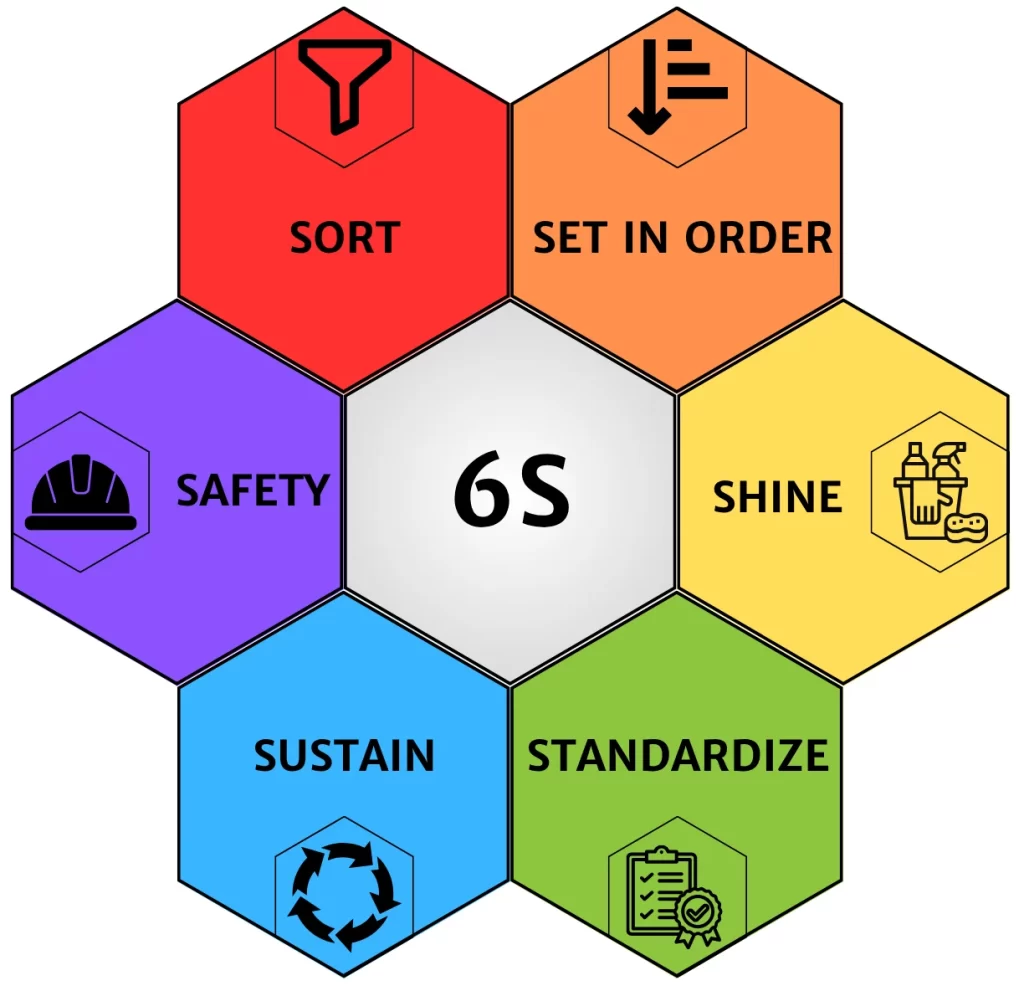
6S is a workplace organization system designed to create a clean, efficient, and safe working environment. It builds upon the well-established 5S methodology with the addition of a sixth pillar, Safety.
Here’s what the acronym stands for:
6S isn’t just about tidiness or appearances. It’s about:

When tools, materials, and information are disorganized, valuable time is wasted searching, waiting, or redoing work. 6S eliminates these inefficiencies by ensuring everything has its place and is immediately accessible reducing motion waste, downtime, and overprocessing.
A clean and standardized environment makes it easier to detect abnormalities early, such as defects, leaks, wear, or contamination. Visual cues help reinforce correct procedures, reducing the likelihood of errors and enabling a more consistent product output.

When workspaces are organized and maintained, employees feel a sense of pride and control over their environment. 6S encourages team involvement and responsibility, which increases engagement and helps foster a culture of continuous improvement.
Cluttered floors, misplaced tools, and poor housekeeping increase the risk of accidents. 6S systematically removes these hazards and integrates safety practices into daily routines making compliance with regulations more natural and workplace injuries less likely.


Well-maintained and orderly equipment is less prone to unplanned failures. By incorporating cleaning and visual inspections into daily tasks, 6S improves preventative maintenance and reduces breakdowns which translates to higher equipment uptime and more stable production.
An organized, well-labeled facility projects professionalism whether it’s a customer tour or a regulatory inspection. With clear documentation, visible standards, and a clean work area, 6S ensures the plant is always ready for audits without last-minute scrambles.

When implemented well, 6S becomes a cultural cornerstone that supports every other operational improvement initiative.

The first step is to separate what’s essential from what’s not. This involves evaluating everything in the workspace, tools, materials, documents, and identifying what truly supports daily operations.
Key Practices:
Challenge: Resistance to Letting Go
Many employees hesitate to discard tools, parts, or materials, fearing they might need them someday. This leads to accumulation of unnecessary items that clutter work areas and hinder efficiency.
Solution: Use a Red-Tagging System with Clear Guidelines
Implement a red-tag system where questionable items are placed in a holding area with a clear deadline for reassessment. Educate staff on the financial and operational cost of keeping unneeded items, emphasizing how clutter adds motion waste, inventory issues, and even safety risks

Once only necessary items remain, they must be arranged in a logical, ergonomic, and easily accessible way. This reduces wasted time and motion.
Key Practices:
Challenge: Poorly Designed Organization Systems
Storage solutions or workstation layouts are sometimes created without considering actual work patterns, leading to inefficient access and unnecessary movement.
Solution: Design with Operator Input and Visual Tools
Involve operators in organizing tools and materials, they know best what they use most often. Use color-coded labels, shadow boards, and floor markings to make storage intuitive. Reinforce the principle: “A place for everything, and everything in its place.”

More than just cleaning, this step involves inspection, ownership, and maintenance to prevent defects and breakdowns.
Key Practices:
Challenge: Cleaning Feels Like an Extra Task
Cleaning is often seen as a non-value-added chore or the responsibility of maintenance staff, resulting in neglect and buildup of dirt, debris, or wear-related issues.
Solution: Make Cleaning Part of the Job with Ownership
Assign cleaning tasks as part of daily duties with visual cleaning standards (e.g., before-and-after photos). Tie cleaning to machine inspection, so operators understand that “shine” is also about spotting problems early. Recognize teams for clean, well-maintained zones.

Standardization ensures the improvements from the first three S’s are sustained and replicated across teams and shifts.
Key Practices:
Challenge: Standards Exist but Aren’t Followed
Procedures are documented, but they gather dust. Without reinforcement, standards drift and variability returns, especially across shifts or departments.
Solution: Build Feedback Loops and Ownership
Make standards visible at the point of use. Train employees not just on what to do, but why it matters. Include 6S checks in shift handovers or daily Gemba walks. Empower teams to continuously improve the standards themselves so they own the system.

The fifth S is about embedding 6S into the culture. Without it, earlier gains can erode over time.
Key Practices:
Challenge: Initial Excitement Fades
After a strong start, 6S enthusiasm declines. Without follow-up, 6S becomes a one-time activity rather than a habit.
Solution: Create Accountability and Recognition
Appoint zone champions or 6S leaders to maintain momentum. Establish a regular audit schedule and link results to team KPIs or reward programs. Celebrate milestones (like “100 days sustained”) and share success stories across the organization to keep morale high.

The newest “S” integrates proactive safety into every element of the workplace.
Key Practices:
Challenge: Safety as Compliance, Not Culture
Workers may follow PPE rules or checklists but don’t internalize safety as a personal responsibility. Hazards go unreported until there’s an incident.
Solution: Embed Safety into Daily Thinking
Encourage active participation in safety observations. Use real examples and near-miss stories during toolbox talks to make risks relatable. Reward teams for proactive safety behaviors. Align safety metrics with employee well-being, not just compliance data.
Implementing 6S isn’t just a housekeeping initiative, it’s an operational strategy. When the workspace is safe, organized, and standardized, your processes flow better, your team performs better, and your entire business becomes more resilient. To keep that momentum going, our 6S Audit Template can help you track progress, identify gaps, and sustain improvements over time.
6S is not a one-time event. It’s a mindset shift, a foundation for operational excellence.
IMEG’s industrial engineering consultants specialize in practical 6S implementation strategies that align with your facility’s unique operations. Whether you’re starting from scratch or refreshing a stalled initiative, we can help bring clarity and control back to your floor.
Let’s build a safer, more efficient operation one S at a time.
Contact Us