
In today’s competitive manufacturing landscape, efficiency is no longer just a goal – it’s a necessity. While many organizations chase big, transformational changes, the most successful ones understand that long-term success is often built on a series of small, consistent improvements.
That is where Kaizen activities come into play. Rooted in the Japanese philosophy of Kaizen, which means “change for the better,” these simple yet powerful tools help manufacturers eliminate waste, engage employees, and create a culture of continuous improvement.
Whether managing operations, leading a quality department, or driving Lean initiatives, this blog will provide better understanding of Kaizen activities and how to apply them in real-world shop floor environments.
Kaizen activities are short-term, targeted initiatives that bring together cross-functional teams to solve problems and improve processes. Rather than relying on major capital investments or large-scale projects, Kaizen focuses on small, manageable changes that are often low-cost but have a high impact.
What makes Kaizen unique is its emphasis on involvement. Everyone from operators to plant managers play a role. The goal is to continuously improve safety, quality, delivery, cost, and morale in a sustainable way.
Manufacturing companies operate in a world of tight margins, growing customer expectations, and constant pressure to reduce costs. Kaizen activities provide a structured yet flexible way to:
In short, Kaizen turns improvement from a once-a-year event into an everyday habit.
In this section, we have laid out some of the most effective and widely used Kaizen activities across manufacturing environments. IMEG has proven experience in conducting these activities for its clients whenever applicable and necessary. Utilizing carefully curated IMEG SOP’s and Templates make the activities organized, valuable, and successful.
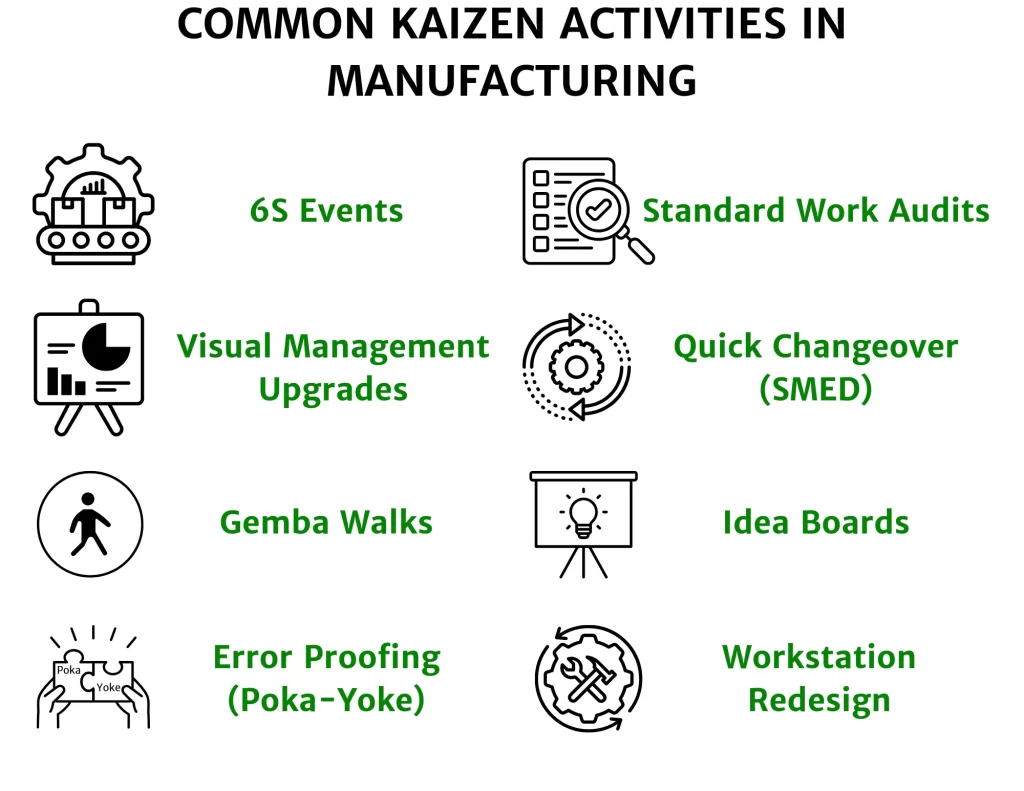
The 6S methodology (Sort, Set in Order, Shine, Standardize, Sustain, Safety) is a foundational Kaizen tool. It focuses on organizing workspaces for efficiency and effectiveness. A clutter-free, well-labeled environment not only improves productivity but also reduces accidents and boosts morale.
These activities involve comparing actual work practices to documented standards. By identifying inconsistencies, teams can refine processes, improve training, and reduce variation – all things that are critical for maintaining quality at scale.
Kaizen events that apply SMED (Single-Minute Exchange of Dies) principles aim to reduce setup and changeover times. This boosts machine availability and supports smaller batch production – key to Lean flexibility.
Visual controls like shadow boards, color-coded labels, and floor markings make problems easier to spot and fix. They also enhance communication across shifts and teams.
“Gemba” means “the real place” in Japanese. During a Gemba Walk, leaders visit the production floor to observe processes, talk with operators, and identify improvement opportunities. These walks promote collaboration and uncover insights that data alone can’t provide.
Idea boards (digital or physical) provide a simple way for frontline employees to submit improvement ideas. When supported by management and tracked for results, they can become a powerful driver of cultural change.
Reconfiguring a workstation for better ergonomics, flow, or access to tools can drastically reduce motion waste and fatigue, leading to higher productivity and lower injury rates.
Simple devices or process changes, like a sensor that prevents a machine from running without a part in place, can prevent costly errors before they occur.
Whether facilitating a 3-day blitz or a focused half-day improvement session, Kaizen activities should follow a structured approach. IMEG recommends the following structure to achieve success.
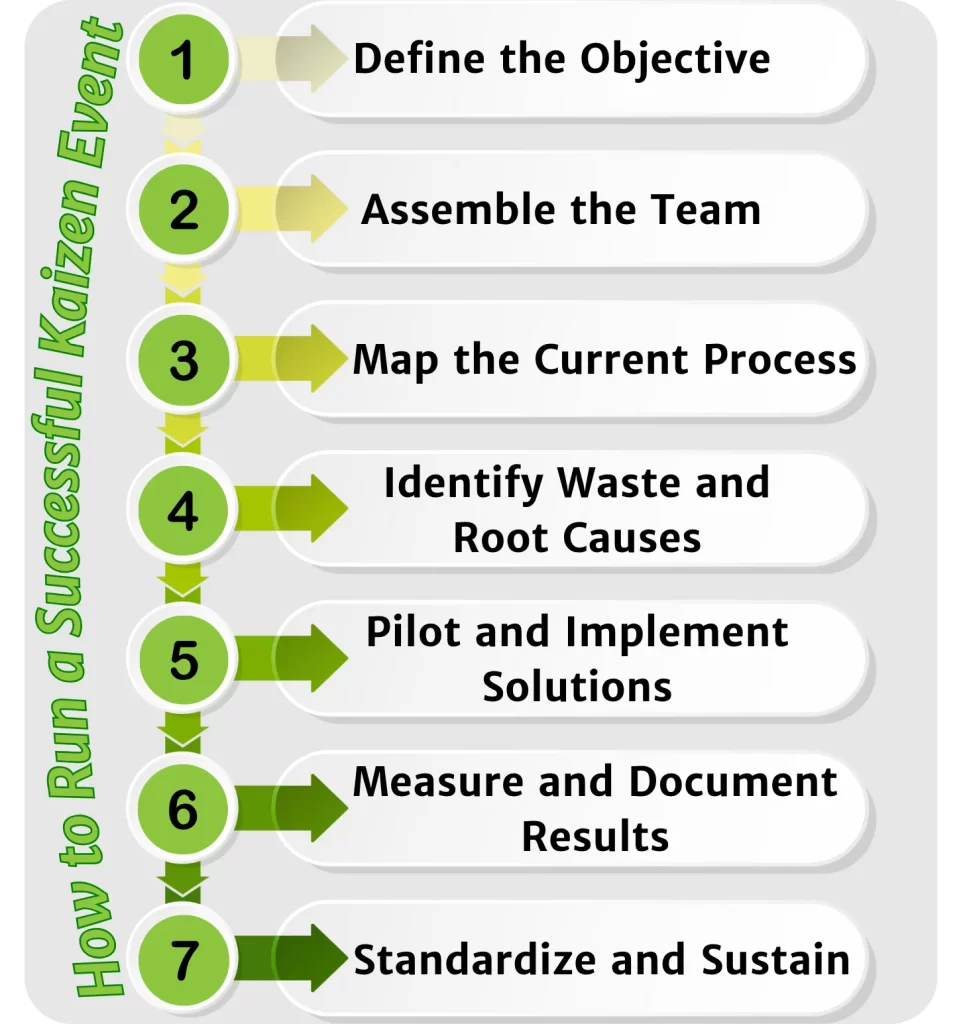
Many organizations struggle not with making improvements (especially if IMEG is supporting them) but with sustaining them. Here’s how to prevent undesired retracement and backsliding:
Kaizen doesn’t have to be complicated to be effective. Start with a single work area or process, engage your team, and build from there. Over time, these small improvements will compound into significant gains in productivity, quality, and culture.
At IMEG, we help manufacturers plan, facilitate, and sustain Kaizen activities that deliver results. Whether you need support for a specific event or want to build an internal continuous improvement program, we’re here to help and put plans into action.
Contact Us