

SOPs are formal documents that describe how to perform routine manufacturing processes in a consistent, safe, and efficient manner. They provide structure, clarity, and control across machines, shifts, and teams and serve as the foundation for process standardization in manufacturing.
An effective SOP outlines what needs to be done, when and why it’s done, and who is responsible. They preserve expertise, reduce risk, and improve performance without relying on memory or guesswork.
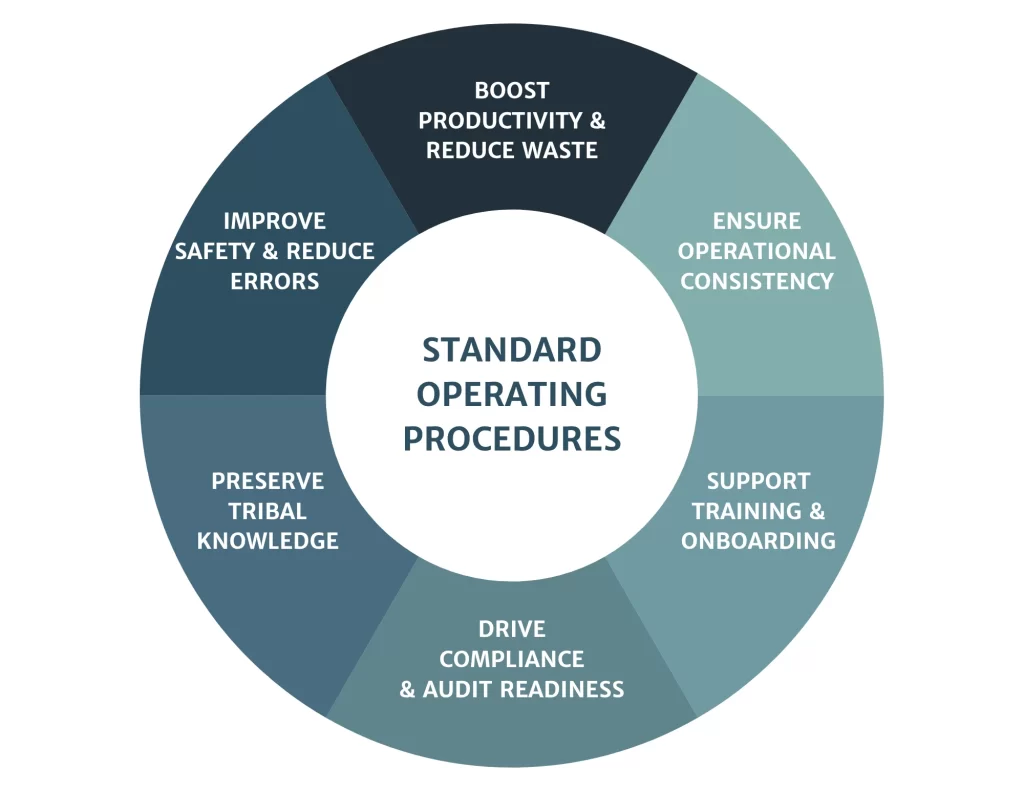
SOPs help manufacturing organizations:
Here’s a practical step-by-step approach:
Start with a process that needs standardization one that’s repeated often, affects quality, involves safety, or causes delays. Focus on tasks prone to variation or reliant on memory or tribal knowledge.
Involve the people who do the work. Walk through the process with operators, technicians, or leads to ensure the SOP reflects reality. Their input improves accuracy and encourages buy-in.
List steps in a clear, logical order. Include decision points, quality checks, and hazards. Define who is responsible and ensure the sequence supports safe, efficient flow.
Write in active voice using clear verbs e.g., “Tighten bolt to 25 Nm.” Avoid jargon, vague terms, or assumptions about prior knowledge. Aim for clarity even for new employees.
Explain why a step matters: to prevent defects, ensure safety, or stay compliant. For example: “Skipping this step may cause warping.” Context reinforces correct execution.
Use images, diagrams, or flowcharts to reduce confusion. Visuals help identify parts, tools, or safety zones and support faster training, especially for non-native speakers.
Test the SOP with a small group. Observe execution and gather feedback. Adjust if needed, then route for approval through quality, engineering, or operations.
Train staff using the SOP, demonstrate key steps, and answer questions. Post the SOP where it’s needed, printed at the station or accessible digitally via MES or internal systems.
While often used interchangeably, SOPs and work instructions serve different purposes and have different scopes.
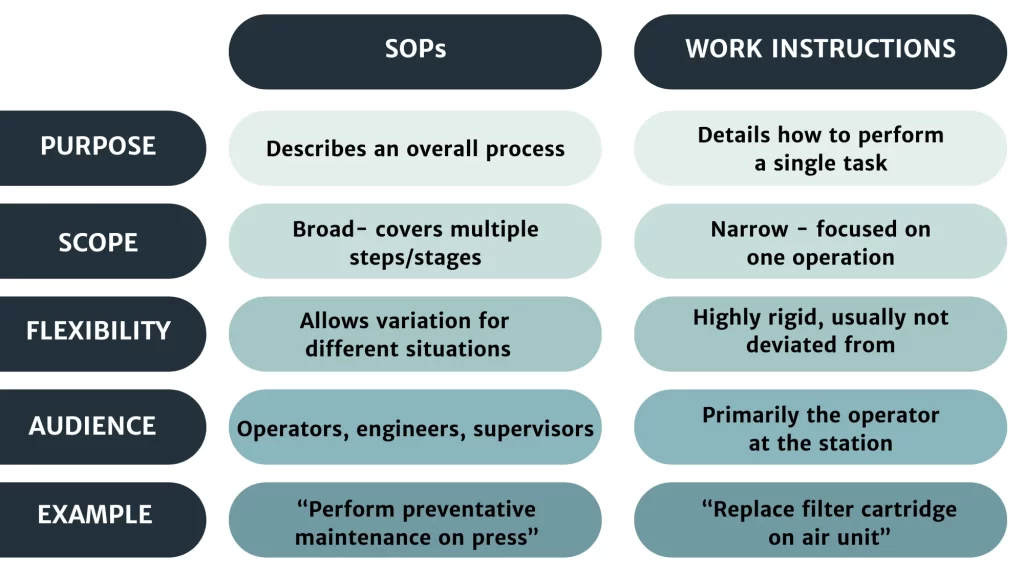
Think of it this way: an SOP might explain the process for starting a CNC machine for a production run, including who checks the job card, what safety gear is needed, and what documentation must be filled out. The work instruction, however, would describe precisely how to load the part, set the fixture, enter program parameters, and verify the first piece.
One is not a substitute for the other. In fact, work instructions often exist as a subset of SOPs, the SOP references the work instruction where more detail is needed. Together, they form a complete documentation system that supports training, accountability, and process control.
Even the best-written SOPs fail if not maintained or followed:

SOPs should be reviewed regularly and updated after process changes or improvements.

Engage operators during drafting, they know what actually happens on the floor.
Keep it simple and clear. If technical terms are required, define them or use visuals.

Use QR codes, digital dashboards, or printed copies near workstations.

Supplement instructions with photos or videos to bridge language or literacy gaps.
Well-documented SOPs empower teams, reduce training time, and support continuous improvement. They’re a cornerstone of Lean, ISO, and Six Sigma frameworks enabling smoother process audits, kaizen events, and productivity gains.
In a rapidly changing manufacturing environment, having clear SOP documentation improves agility, traceability, and overall process control.
Tribal knowledge has value, but it can’t be your only safety net. SOPs capture and scale that knowledge, turning individual excellence into team-wide performance.
They’re not just paperwork they’re your playbook for quality, safety, and repeatable success.
We help manufacturers design SOPs that are practical, visual, and aligned with floor realities. Whether it’s documenting existing processes or creating new ones, our engineering team brings structure, clarity, and expertise to your operation.
Let’s bring consistency and confidence to your shop floor - reach out today.
Contact Us